

A cancer diagnosis can quickly lead to an overwhelming number of decisions. Along with conversations about surgery, chemotherapy, radiation, immunotherapy, or other conventional treatments, many patients begin researching nutrition, complementary therapies, IV therapies, lifestyle support, and integrative cancer care.
The challenge is knowing which options are appropriate for you and which providers you can trust.
Integrative cancer care is not simply about offering more therapies. A thoughtful program should consider your diagnosis, current treatment plan, overall health, medications, symptoms, nutritional needs, and personal goals before recommending supportive care.
The National Cancer Institute defines integrative medicine as an approach that combines conventional medical treatment with complementary practices that have evidence supporting their safety and effectiveness. Complementary therapies are generally intended to be used alongside standard cancer treatment rather than automatically replacing it.
If you are considering an integrative cancer center, these eight questions can help you evaluate your options.
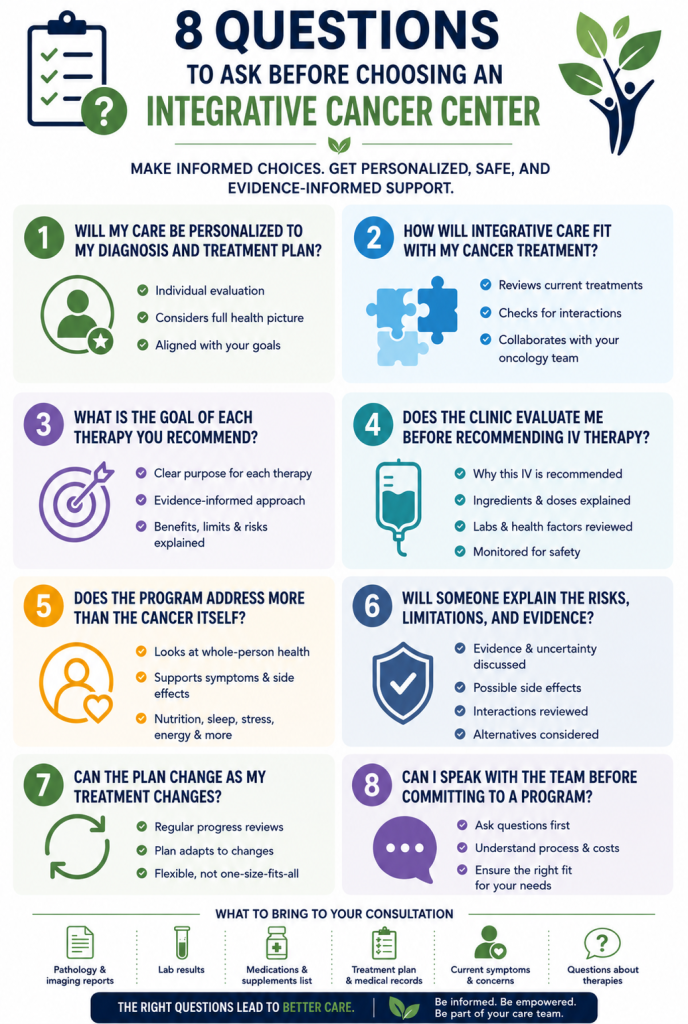
1. Will My Care Be Personalized to My Diagnosis and Treatment Plan?
Cancer is not a single disease, and two people with the same type of cancer may have very different medical histories, treatments, symptoms, and priorities.
That is why personalized care matters.
Before beginning an integrative program, ask how the medical team determines which therapies may be appropriate for you. A thorough evaluation may take into account factors such as:
- Your cancer type and stage
- Current or planned oncology treatments
- Medications and supplements
- Laboratory findings
- Medical history
- Nutritional status
- Treatment-related symptoms
- Energy, sleep, stress, and quality of life
- Your individual goals and concerns
The important question is not simply, “What treatments does this clinic offer?”
It is, “Why is this particular treatment being recommended for me?”
A provider should be able to explain how each recommendation relates to your individual health situation.
2. How Will Integrative Care Fit With My Conventional Cancer Treatment?
This is one of the most important questions you can ask.
Integrative cancer care should account for the treatments you are already receiving or considering with your oncology team.
Some complementary approaches may help patients manage particular symptoms or support quality of life. Evidence-based oncology guidelines, for example, include certain mind-body approaches, acupuncture, exercise, and other supportive interventions for selected cancer-related symptoms and treatment side effects.
At the same time, complementary does not mean risk-free. Supplements, medications, and other therapies can interact with cancer treatments, so communication among healthcare providers is important.
Ask an integrative clinic:
- Do you review my current medications and cancer treatments?
- Will you consider possible therapy interactions?
- Should my oncologist know about the treatments I receive here?
- How do you decide when a complementary therapy is or is not appropriate?
A responsible medical team should be comfortable discussing both potential benefits and limitations.
3. What Is the Goal of Each Therapy You Recommend?
Patients sometimes encounter long lists of treatments while researching integrative medicine.
More treatment is not necessarily better treatment.
For every therapy being considered, ask what the specific goal is.
Depending on the patient’s circumstances, supportive care may focus on areas such as nutrition, symptom management, maintaining physical function, stress management, or general well-being during treatment.
Some therapies are also being actively studied for potential roles in cancer care. Intravenous vitamin C, for example, has been evaluated in clinical research, but additional research is still needed, and it should not be presented as an established cure for cancer.
This distinction matters.
A thoughtful integrative plan should explain what a therapy is intended to do, what evidence exists, what uncertainties remain, and what risks should be considered.
4. Does the Clinic Evaluate Me Before Recommending IV Therapy?
IV therapy is commonly associated with integrative medicine, but an IV treatment should not be chosen simply because it is popular.
Intravenous administration allows substances to enter the bloodstream directly, but that alone does not establish that a particular IV formulation will improve a specific health condition.
Evidence supporting broad wellness claims for IV vitamin infusions is limited, particularly in otherwise healthy individuals, and IV therapy can carry potential risks.
For patients with cancer or complex medical conditions, individualized evaluation becomes especially important.
Before receiving IV therapy, ask:
- Why is this IV being recommended?
- What ingredients and doses are included?
- Are laboratory tests needed beforehand?
- Are there kidney, medication, or other health considerations?
- How will I be monitored during treatment?
- What side effects or risks should I know about?
The purpose of these questions is not to assume that IV therapy is appropriate or inappropriate. It is to understand why a specific treatment is being considered for your individual situation.
5. Does the Program Address More Than the Cancer Itself?
Cancer can affect much more than the disease itself. Patients may also experience changes in appetite, sleep, physical strength, stress levels, emotional well-being, and everyday quality of life. This is one area in which integrative care may have a supportive role.
The Society for Integrative Oncology and the American Society of Clinical Oncology have developed evidence-based guidelines examining integrative approaches for symptoms experienced by people with cancer, including pain, anxiety, depression, and other treatment-related concerns.
When evaluating a center, ask whether the program looks beyond individual procedures and considers the broader experience of living through cancer treatment.
Depending on your needs, that may include discussions about:
- Nutrition
- Physical activity
- Sleep
- Stress management
- Treatment-related symptoms
- Emotional well-being
- Maintaining strength and daily function
The goal should be to understand the patient as a whole person while remaining attentive to the realities of their medical diagnosis and treatment.
6. Will Someone Explain the Risks, Limitations, and Evidence?
Be cautious when any healthcare provider guarantees outcomes or presents one therapy as effective for virtually everyone.
Cancer is complex, and responsible medical care requires realistic discussions.
The National Center for Complementary and Integrative Health notes that complementary health approaches should not be presented as proven methods for preventing or curing cancer. Patients are also encouraged to discuss complementary approaches with their healthcare professionals.
That does not mean integrative medicine has no role.
It means the role of each therapy should be described accurately.
During a consultation, you should feel comfortable asking:
- What evidence supports this recommendation?
- What is still uncertain?
- What are the possible side effects?
- Could this interact with another treatment?
- How will we determine whether it is helping?
- What alternatives should I consider?
A trustworthy provider should be willing to discuss uncertainty and limitations rather than focusing only on potential benefits.
7. Can the Plan Change as My Treatment Changes?
Cancer treatment is rarely static.
Medications can change. Surgery dates can move. Laboratory values fluctuate. Symptoms appear and resolve. Treatment goals can evolve.
An integrative care plan should be able to evolve as well.
Ask how often your progress will be reviewed and what happens if your conventional cancer treatment changes.
Rather than following a rigid protocol, personalized integrative care should continue to reflect your current health status and treatment circumstances.
This can be especially important for patients receiving care from several healthcare providers at the same time.
8. Can I Speak With the Team Before Committing to a Program?
You should have an opportunity to understand a clinic’s philosophy before making a significant care decision.
A preliminary conversation can help you learn:
- Whether the clinic commonly works with patients in situations similar to yours
- What the evaluation process involves
- Whether care is available in person, virtually, or both
- What records or laboratory results you should provide
- What treatment frequency might look like
- What costs you should anticipate
- Whether the clinic’s approach appears compatible with your goals
- What happens if the provider does not believe a particular therapy is appropriate for you
Pay attention not only to what treatments are discussed, but also to how your questions are answered.
A good initial conversation should help you understand the clinic’s approach without making you feel pressured to commit to a treatment plan.
What to Bring to an Integrative Cancer Consultation
Preparing in advance can make your consultation more useful.
Consider gathering:
- Your pathology report
- Recent imaging reports
- Recent laboratory results
- A current medication and supplement list
- Your oncology treatment plan
- Relevant medical records
- A list of your current symptoms
- Questions about therapies you are already researching
Also think about what you most want help with.
For one patient, the priority may be navigating nutrition during treatment. Another may be interested in supportive therapies, treatment-related fatigue, or understanding how an integrative plan could fit alongside conventional oncology care.
Clear priorities can help the medical team better understand what matters most to you.
Exploring Integrative Cancer Care at Infuze MD
If you are considering integrative cancer care, Infuze MD offers personalized consultations for patients who want to better understand how integrative approaches may fit into their broader medical care.
The clinic works with patients with cancer and complex health concerns and may incorporate areas such as medical evaluation, nutritional and metabolic support, customized IV therapies, and other supportive approaches depending on the patient’s individual circumstances.
The first step does not have to be deciding on a treatment. It can simply be gathering information, asking questions, and determining whether the clinic’s approach is appropriate for your needs.
If you would like to explore whether integrative cancer care may be appropriate for your diagnosis, current treatment plan, and health goals, you can schedule a Discovery Call with the Infuze MD team.
Key Takeaways
- Integrative cancer care should be personalized rather than based on a one-size-fits-all protocol.
- Complementary therapies are generally intended to work alongside appropriate conventional cancer care.
- Ask why each therapy is being recommended and what evidence, risks, and limitations should be considered.
- Your medications, laboratory results, cancer treatments, and medical history should be reviewed before starting new therapies.
- A responsible provider should be willing to discuss uncertainty, possible interactions, and treatment limitations.
- Your integrative care plan may need to change as your health and oncology treatment change.
- An initial consultation can help you evaluate a clinic’s approach before deciding whether to move forward.