
Cancer care involves more than treating the disease itself. Many patients also look for ways to support their overall health, manage treatment-related challenges, and maintain their quality of life throughout treatment and recovery.
As interest in integrative oncology grows, researchers are exploring naturally derived compounds that may have a role in cancer care. One of these is curcumin, the active compound found in turmeric, which has attracted scientific attention for its anti-inflammatory, antioxidant, and potential anticancer properties.
However, curcumin is poorly absorbed when taken orally, prompting researchers to investigate alternative delivery methods, including intravenous (IV) administration. While this approach may improve the amount of curcumin reaching the bloodstream, questions remain about its effectiveness and safety for cancer patients.
Understanding how IV curcumin works, what research has found, and where it may fit within integrative cancer care can help patients make more informed decisions.
What Is IV Curcumin?
Curcumin is a naturally occurring compound found in turmeric (Curcuma longa), a plant traditionally used in Asian medicine. Researchers have studied curcumin for its effects on inflammation, oxidative stress, and cellular signaling pathways involved in various health conditions.
One of the main challenges with oral curcumin is its low bioavailability. When consumed, much of the compound is poorly absorbed or rapidly metabolized, limiting the amount of unchanged curcumin that reaches the bloodstream.
IV curcumin is an investigational approach that delivers a specially formulated curcumin preparation directly into the bloodstream, bypassing gastrointestinal absorption. Researchers have explored this method to determine whether greater systemic exposure could support further investigation into curcumin’s biological effects.
Why Is Curcumin Being Studied in Cancer Care?
Curcumin has attracted interest in oncology because it influences several biological processes associated with inflammation, cellular stress, and cancer cell behavior. According to the National Cancer Institute’s review of curcumin and cancer research, laboratory studies have identified several mechanisms that may warrant further investigation, although these findings have not established curcumin as an effective cancer treatment in humans.
Inflammation and Cellular Signaling
Chronic inflammation can contribute to biological conditions that influence cancer development and progression. In laboratory studies, curcumin has been shown to affect inflammatory signaling pathways, including NF-κB, which helps regulate inflammation and cellular responses.
These findings have encouraged researchers to explore whether curcumin could influence inflammation-related processes in cancer. However, clinical evidence has not established that IV curcumin meaningfully reduces cancer-related inflammation or improves patient outcomes.
Oxidative Stress and Cellular Protection
Another area of interest is curcumin’s relationship with oxidative stress, which occurs when reactive oxygen species exceed the body’s ability to regulate them. Experimental studies suggest that curcumin can influence antioxidant-related pathways involved in cellular defense.
Its effects are complex, however, because curcumin may also promote oxidative processes under certain conditions. This is particularly relevant in cancer care, where some conventional treatments rely partly on oxidative damage to destroy cancer cells. Researchers are continuing to investigate these interactions to better understand their potential clinical significance.
Cancer Cell Growth and Survival
Curcumin has also been studied for its effects on processes involved in cancer cell growth and survival. Laboratory findings suggest that it can influence cell proliferation, programmed cell death, cellular signaling, and mechanisms associated with tumor invasion.
Although these findings provide a scientific basis for continued research, results observed in laboratory cancer cells do not necessarily reflect what happens in the human body. Larger, well-designed clinical trials are needed to determine whether these effects translate into meaningful benefits for patients.
Interactions With Conventional Cancer Treatments
Researchers have also investigated whether curcumin may influence how cancer cells respond to chemotherapy or radiation. Some preclinical studies have suggested changes in treatment sensitivity, but the findings vary depending on the cancer type, medication, formulation, and dose.
Because curcumin may also interact with certain medications, it should not be assumed to enhance conventional cancer treatment. Patients receiving chemotherapy, radiation, immunotherapy, or other cancer therapies should discuss curcumin use with their oncology team before considering it.
Why Are Researchers Investigating IV Curcumin?
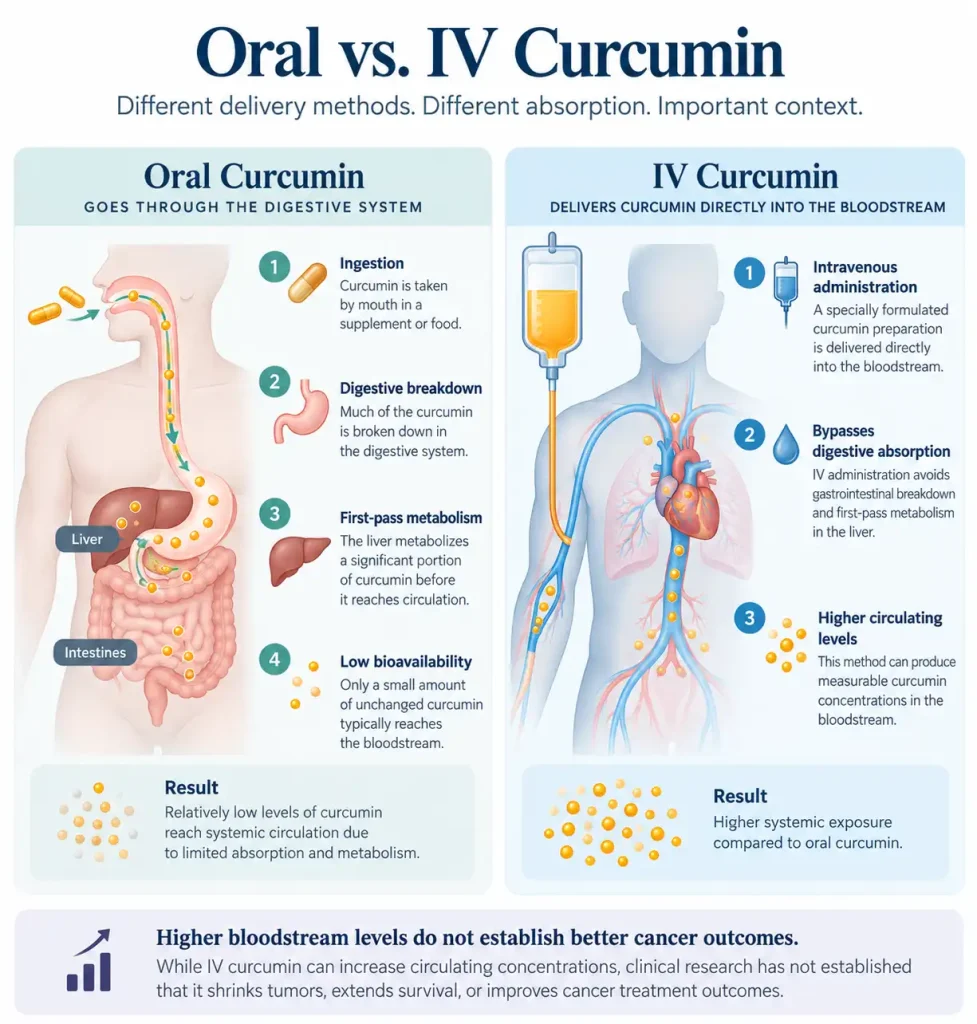
Although curcumin has demonstrated interesting biological activity in laboratory research, its poor oral bioavailability presents a challenge when studying its effects in humans. After ingestion, relatively little unchanged curcumin typically reaches systemic circulation.
To address this limitation, researchers have developed alternative formulations, including liposomal curcumin, which uses lipid-based carriers to help deliver the compound. Intravenous administration bypasses gastrointestinal absorption and allows researchers to examine circulating curcumin concentrations more directly.
This approach may help scientists better understand curcumin’s behavior in the body, but important questions remain about appropriate dosing, long-term safety, medication interactions, and whether increased systemic exposure produces meaningful clinical benefits.
Until these questions are answered through rigorous research, IV curcumin should be considered an experimental intervention rather than an established cancer therapy.
What Does Clinical Research Say About IV Curcumin for Cancer?
While laboratory studies have generated interest in curcumin’s potential applications, clinical research involving intravenous administration remains limited.
A 2018 phase 1 clinical study of intravenous liposomal curcumin evaluated its safety, tolerability, and preliminary anticancer activity in 32 patients with locally advanced or metastatic cancer. Researchers found that IV administration produced measurable circulating curcumin concentrations, although these levels declined rapidly after infusion.
The study did not demonstrate objective tumor responses under standard RECIST criteria. Researchers also identified safety concerns, including hemolysis, which involves the destruction of red blood cells, and reductions in hemoglobin levels.
These findings highlight the importance of distinguishing laboratory activity from proven clinical effectiveness. A 2024 evidence review of intravenous curcumin in cancer care similarly concluded that available evidence was insufficient to establish its effectiveness, safety, optimal dosing, or potential medication interactions.
Research is continuing, including a clinical trial investigating liposomal curcumin alongside standard treatment for high-grade gliomas. However, ongoing investigation should not be interpreted as evidence that a therapy is effective.
Can Curcumin Help With Cancer Treatment Side Effects?
Beyond its potential effects on cancer-related biological pathways, curcumin has also been investigated for its possible role in managing certain treatment-related symptoms.
Small clinical studies involving oral or topical curcumin have explored concerns such as oral mucositis, radiation-related skin reactions, and quality of life. Some findings have suggested potential benefits, although results remain inconsistent and study methods vary considerably.
An important distinction is that most of this supportive-care research has involved oral or topical formulations rather than IV curcumin. Benefits observed with one method of administration cannot automatically be applied to another.
For patients experiencing fatigue, inflammation, digestive concerns, or other treatment-related symptoms, established supportive care approaches remain important. An integrative oncology consultation may help identify options appropriate for the patient’s symptoms, medical history, and current treatment plan.
How Does IV Curcumin Fit Into Integrative Cancer Care?
Integrative oncology takes a comprehensive approach to cancer care by combining conventional medical treatment with supportive strategies that address physical, emotional, and overall well-being.
Rather than focusing on a single therapy, integrative care considers the patient’s broader health needs, including nutrition, fatigue, stress, sleep, symptom management, and recovery. The goal is to support quality of life while keeping established cancer treatments at the center of care.
The National Center for Complementary and Integrative Health’s guidance on complementary approaches in cancer care emphasizes the importance of evaluating these therapies for safety and effectiveness, particularly when they are used alongside conventional treatment.
Within this framework, IV curcumin may be discussed as an investigational approach, but it should not be presented as a proven cancer treatment or an established supportive therapy. Patients interested in emerging interventions may benefit from discussing available clinical trials and reviewing the evidence with their oncology team.
This coordinated approach helps ensure that decisions about supportive care are based on individual health needs, treatment goals, and potential risks.
Is IV Curcumin Safe?
Although curcumin is derived from turmeric, concentrated intravenous formulations have different safety considerations from turmeric consumed in food.
Early clinical studies have identified concerns involving red blood cells and hemoglobin levels, including hemolysis. These findings demonstrate that IV curcumin should not be considered risk-free simply because it comes from a natural source.
Medication interactions are another important consideration. Curcumin may affect certain chemotherapy medications, anticoagulants, and other drugs. Liver injury has also been reported with some curcumin-containing products, although these reports do not establish the same level of risk for every formulation or route of administration.
The Memorial Sloan Kettering Cancer Center’s guidance on turmeric and curcumin safety highlights potential medication interactions and precautions relevant to patients undergoing cancer treatment.
Intravenous administration also carries general infusion-related risks, including infection, vein irritation, and reactions to formulation ingredients. Because long-term safety data remain limited and no universally established IV curcumin protocol exists for cancer care, patients should discuss the potential risks with their treating oncologist.
What Should Patients Consider Before Exploring IV Curcumin?
For patients interested in IV curcumin, the most important consideration is whether the available evidence supports its use for their individual circumstances.
Cancer type, stage, current treatment, medical history, and medication use can all influence the safety of complementary or investigational approaches. Patients should ask whether the proposed therapy is being studied in a registered clinical trial, what formulation is involved, and whether potential interactions with their existing treatments have been evaluated.
It is also important to distinguish between therapies that have demonstrated clinical benefits and those that remain experimental. While emerging research can be encouraging, it does not necessarily mean an intervention is ready for routine patient care.
Discussing these questions with an oncology team can help patients evaluate their options while protecting the effectiveness and continuity of their conventional treatment.
Exploring Personalized Integrative Cancer Care at Infuze MD
Every cancer experience is different, and patients often have unique concerns related to treatment, recovery, and overall well-being. Personalized integrative care provides an opportunity to address these needs through a comprehensive approach that considers the individual rather than focusing solely on a diagnosis.
At Infuze MD, integrative care emphasizes understanding each patient’s health goals and exploring supportive strategies that can complement appropriate conventional cancer treatment. This may include discussions about nutrition, treatment-related symptoms, lifestyle factors, and emerging therapies.
For patients curious about IV curcumin, a consultation can provide an opportunity to better understand the available research, review potential safety concerns, and explore supportive care options that may be more appropriate for their individual needs.
Medical note: IV curcumin is investigational and is not FDA-approved to prevent, treat, or cure cancer. It should not replace or delay conventional oncology treatment.
Key Takeaways
- Curcumin is a naturally occurring compound found in turmeric that has been studied for its anti-inflammatory and potential anticancer properties.
- IV curcumin bypasses gastrointestinal absorption, but increased bloodstream exposure does not necessarily improve cancer outcomes.
- Laboratory research has identified potential effects on cancer-related pathways, although human clinical evidence remains limited.
- Current studies have not established that IV curcumin improves tumor response, survival, or quality of life.
- Potential safety concerns include blood-related complications, medication interactions, and infusion-related risks.
- Patients should consult their oncology team before considering investigational therapies.
- Integrative cancer care focuses on personalized, evidence-based support alongside conventional treatment.